
Jane Beckmann, Overton Biodiversity Working Group
August 2026
When I moved to Overton in the summer of 2004, I was delighted by the number of swifts in the village. Older residents will remember even larger numbers. For many years, one of the defining sounds of summer was the sight and sound of swifts gathering in noisy “screaming parties” above Station Road, Winchester Street and Dellands. Sadly, those exhilarating aerial displays have become much rarer.
As you read this in August, many of our swifts will already have begun their extraordinary journey back to sub-Saharan Africa, where they spend the winter. They usually arrive in the UK in early May, raise just one brood of two or three chicks, and then leave again by late July or early August. Despite spending only a few months here, Britain is a vital breeding ground for these remarkable birds.
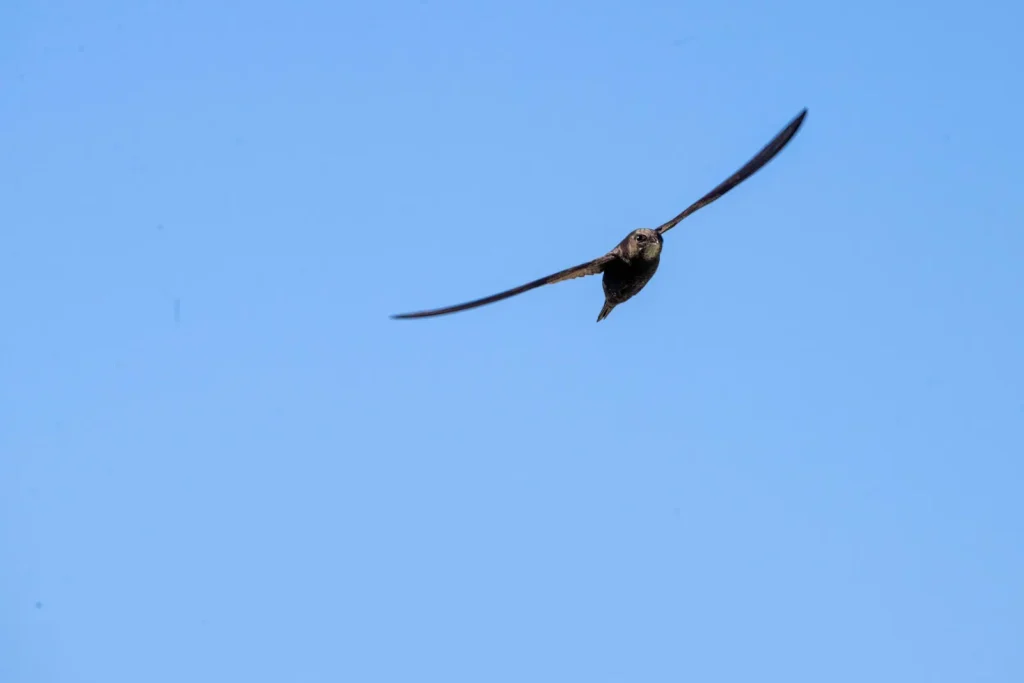
Swifts are incredible travellers. They routinely cover around 500 miles (800 km) in a single day during migration. Using lightweight geolocators, the British Trust for Ornithology has tracked birds making the 3,000-mile (5,000 km) journey from West Africa to Britain in as little as five days.
Surprisingly, swifts are more closely related to hummingbirds than to swallows or house martins. They spend almost their entire lives in the air, eating, drinking, sleeping and even mating while in flight, only landing to nest. Their scientific name, Apus apus, means “without feet”. Although they do have feet, they are tiny, with sharp claws perfectly adapted for clinging to vertical surfaces rather than perching on branches or wires.
Their diet consists of what scientists call “aerial plankton” tiny flying insects, spiders and other airborne invertebrates carried on air currents. A single swift can eat thousands of insects every day, making them an important part of our natural ecosystem.
Five amazing facts about swifts!

Swifts spend up to 10 months of the year in the air
They may fly over 100,000 miles in a year.
They eat thousands of flying insects every day.
Young swifts may not land for their first two or three years.
The oldest recorded wild swift lived for more than 20 years.
Most swifts first breed when they are three or four years old. They are remarkably faithful to their nesting sites, often returning to the same location year after year. Adults collect insects into a ball, sometimes holding more than a thousand tiny insects, which they carry in a pouch beneath their tongue to feed their chicks. Once young swifts leave the nest, they may remain continuously airborne for the next two or three years before breeding for the first time.
Thousands of years ago, swifts nested in holes in cliffs and ancient trees. As people built towns and villages, they adapted to nesting in the small gaps beneath roof tiles, behind fascia boards and in old brickwork. Many older buildings in Overton once provided perfect nesting places, often without homeowners even realising swifts were there.
Even today, if you are lucky enough to be enjoying a drink in the garden at Emporia during the summer, you may still catch sight of a pair disappearing into a tiny hole high in the wall. We hope they continue to return for many years to come.
A declining species in Britain
Unfortunately, swifts are now one of Britain’s fastest declining birds. According to the British Trust for Ornithology, breeding populations have fallen by around 70% since 1995, and the species is now on the UK’s Red List of Birds of Conservation Concern.
One of the biggest reasons for this decline is the loss of nesting places. As older buildings are repaired or renovated, small gaps beneath roofs are often sealed, unintentionally blocking traditional nest sites. At the same time, declining insect populations and increasingly unpredictable weather during the breeding season make it harder for adults to find enough food for themselves and their chicks.
Fortunately, there is plenty we can do to help
Specially designed swift nest boxes can successfully replace lost nesting sites and are increasingly being installed across the village. If you walk along Station Road you will see several boxes fitted to houses, while the Church Rooms have nest boxes on the eastern side together with a recording of swift calls to attract young birds searching for their first nesting site. New boxes can sometimes take a year or two to be discovered, but patience is often rewarded. House sparrows, themselves a declining species, are also happy to use them.
Swifts are exceptionally clean birds, so householders need not worry about droppings beneath their nesting sites.
For new buildings, there is an even better solution. Swift bricks are purpose-built nesting spaces built directly into the wall during construction. They are virtually invisible once installed, require no maintenance and will last for the lifetime of the building. Conservation organisations and many local authorities now actively encourage their use because they provide permanent nesting opportunities at very little additional cost.
With proposed new housing in and around Overton, we should encourage developers to include swift bricks as standard. A small feature built into a new home today could provide a nesting place for generations of swifts.
The good news is that swifts readily use suitable nesting sites when they are available. Every nest box and every swift brick increases the chances that these extraordinary birds will continue to breed here.
By protecting existing nests, reducing pesticide use in our gardens to encourage flying insects, recording local swift sightings and supporting wildlife-friendly development, we can all play a part in reversing their decline.
The sight of swifts racing and screaming above our rooftops is one of the great joys of an English summer. It would be a great loss if future generations never experienced that magical sound. Working together as a community, we can help ensure that Overton remains a place where swifts continue to return every spring.
Our thanks go to Catharine Gale, Trustee of Hampshire Swifts, for her help and advice in preparing this article. For more information about swifts and nest boxes, visit https://www.hampshireswifts.co.uk/
For information about swift bricks and integral nest boxes, visit https://www.actionforswifts.com/
Thank you also to Deb Heath of Test Valley Wildlife for the photography and video footage.
Overton Biodiversity is a working group of Overton Parish Council.